Ancient Mariner and the crew
The Rime of the Ancient MarinerThe relationship between the Ancient Mariner and the crew is a passage from common labor to collective condemnation and, finally, absolute separation. They begin as shipmates aboard a vessel that leaves harbour and meets a following south wind; after the Mariner kills the bird credited with bringing that breeze, the crew turns the shared voyage into a judgment on his act. Their deaths leave him surrounded by the bodies of the men who had condemned him, while their accusing eyes continue to define his isolation. The crew is thus at once his working company, the first human voice against his violence, and the measure of the loneliness that follows.
Shared Voyage and Dependence
The relationship begins in practical cooperation. The ship is cheered as it clears the harbour, and the crew departs together below the church and hill. At sea, a good south wind rises behind the ship, and the Albatross follows it. These details place the Mariner among a company whose safety and progress depend on the ship’s movement through weather, not in a solitary adventure detached from human work.
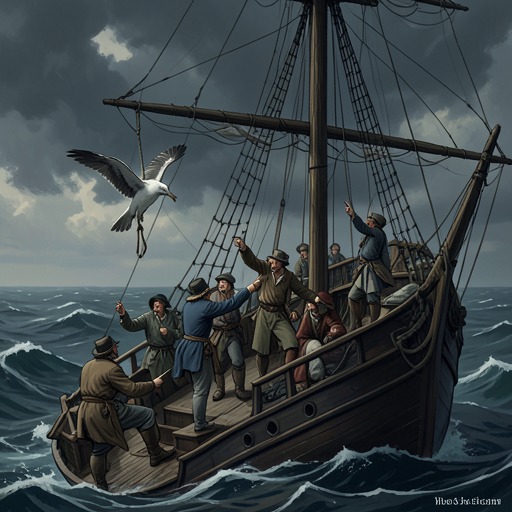
The crew’s dependence on the wind gives the Mariner’s later violence a shared consequence. After the bird is killed, the breeze ceases; the sailors’ calls for food or play are no longer answered by the same passage of the Albatross. The men understand the change through the relation between the bird and the breeze: they say that the Mariner killed the bird that made the wind blow. Their accusation connects a private act to the fortunes of the whole ship.
Condemnation and Reversal
The crew’s response first gives public form to the Mariner’s guilt. He calls his deed hellish and says that it will bring the others woe; the sailors answer that the bird should not have been slain because it had brought the breeze. Their judgment is not distant commentary: they are the people exposed to the consequences of the act, and their agreement fixes blame on the man who committed it.
Their view of the killing then shifts with the weather. When the sun appears, the crew says that the Mariner did right to kill the bird that had brought the fog and mist. This reversal does not erase the earlier charge; it shows the sailors judging the act by the immediate conditions of the voyage. Later, when the ship is becalmed and the men can scarcely speak, the Mariner reports the hostile looks he receives from old and young. The Albatross is put around his neck in place of the cross, making his guilt visible within the company even as the men’s own distress deepens.
The Crew’s Death and the Mariner’s Isolation
The shipmates’ relation to the Mariner ends in a sequence of deaths witnessed by him. One after another, beneath the moon, each man turns his face with a ghastly pang and curses him with his eye. The crew numbers four times fifty living men; the Mariner hears neither sigh nor groan as they die. The count makes the loss a mass death, while the repeated look makes each death register as an accusation directed at him.
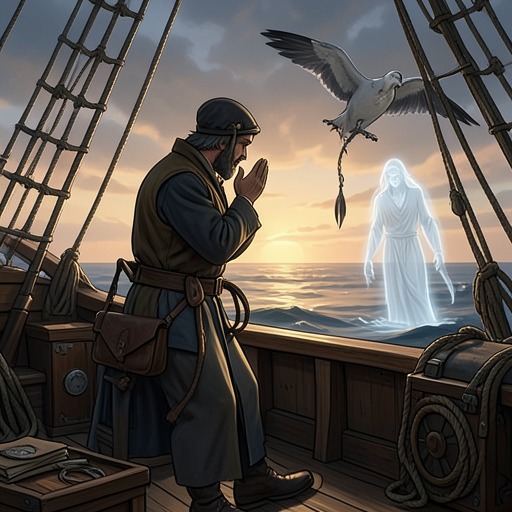
The Mariner remains alive among the dead. He insists to the Wedding-Guest that the body did not fall, then describes himself as alone on the wide sea. Looking at the rotting deck, he sees the dead men lying there and tries to pray, but a wicked whisper interrupts before prayer can come. The crew is no longer available as a community of workers or companions; its presence persists as bodies and condemning eyes, while the Mariner cannot turn either toward fellowship or toward prayer.
Brief Return to Shared Work and Final Separation
Later, the dead sailors rise and work the ship. The helmsman steers and the vessel moves onward, though no breeze blows; the mariners take up the ropes. This supernatural resumption of their familiar duties briefly restores the appearance of a crew at work, but not a living fellowship. The men move the ship without returning to ordinary companionship with the Mariner, and their renewed labor carries the voyage forward rather than repairing the relationship.
Near the end of the voyage, the Mariner hears oars and the Pilot’s cheer, then sees the Hermit, who sings hymns made in the wood. He expects the Hermit to shrieve his soul and begs him to do so when they meet. That appeal marks a contrast with the lost crew: the Mariner seeks confession from a living religious figure after the shipmates who judged him have died. The crew’s story closes not in reconciliation but in the enduring separation created by the Mariner’s offense, their deaths, and his survival.
Significance of the Relationship
The crew’s response makes the consequences of the Mariner’s act social as well as supernatural. Its members share the risks of the voyage, identify the harm as his responsibility, and suffer a fate from which he alone is spared. Their accusing looks extend beyond spoken judgment: even after their deaths, the Mariner’s attempt to pray is blocked, and he remains alone with their bodies.
The poem’s closing moral turns outward from this failed human community. The Mariner tells the Wedding-Guest that prayer belongs with love for man, bird, and beast, and that the best prayer belongs to those who love best. Set against the crew’s condemnation and death, this teaching enlarges the lesson beyond the sailors: the relation that broke between the Mariner and his shipmates is bound to a wider obligation toward living creatures. The crew remains the nearest and most devastating evidence of what his violation costs, while his continuing need to tell the tale carries that cost beyond the voyage.